Introduction
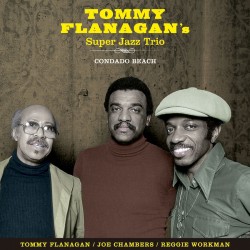
Thomas Lee Flanagan was an American jazz pianist who stood out during the second wave of bebop. His solo work, as an accompanist, or as a bandleader, was characterized by his great harmonic sophistication and outstanding inventiveness.
His work not only influenced musicians of his era but also served as inspiration for subsequent generations of artists worldwide. Tommy Flanagan left an indelible mark on jazz history, and the elegance of his performances continues to be praised even today, more than two decades after his death.
Biography
Flanagan was born on March 16, 1930, in Detroit. He learned to play the piano from his family and performed in some gigs before finishing high school. His first major concert was in 1945 alongside trombonist Frank Rosolino. At that time, he played in a band with Lucky Thompson, Pepper Adams, and Kenny Burrell, and he also performed with Charlie Parker and Rudy Rutherford.
In 1956, he moved to New York, and his career began to flourish thanks to his standout performances in clubs and countless collaborations, where he provided perfect complements to other jazz musicians. One such collaboration was with Sonny Rollins on Saxophone Colossus, considered a masterpiece at the time. That same year, he also began working with Ella Fitzgerald and trombonist J.J. Johnson, gaining worldwide recognition.
1957 was a special year, as he recorded his first album as a bandleader, Overseas, featuring Wilbur Little on bass and Elvin Jones on drums. Amid constant collaborations and some solo appearances, he achieved great success, embarked on numerous tours, and grew his fame.
From 1978 to 2001, after suffering a heart attack and ceasing his collaborations with Ella Fitzgerald, Flanagan focused on his career as a lead artist. In the 1980s, he led several trios, and in the 1990s, he concentrated on his solo performances and recordings, solidifying his reputation as "Tommy Flanagan Jazz Pianist."
His artistic work was always demanding and consistent. Perhaps this contributed to his serious health issues in 1991, requiring bypass surgery and later treatment for an aneurysm.
Despite these challenges, his musical career continued, with highly praised performances until 2001. That same year, on November 16, he passed away at the age of 71 due to complications related to the aneurysm he had suffered a decade earlier.
Musical Influences
Initially, he was influenced by artists like Art Tatum, Teddy Wilson, Nat King Cole, Earl Van Riper, and Willie Anderson, whom he listened to on the radio or saw performing locally in Detroit.
Flanagan, however, was particularly drawn to newer styles like bebop. In this sense, pianist Bud Powell significantly influenced his musical thinking, both in the studio and in his improvisational approach on stage.
Collaborations in Performances
Early in his career, Flanagan participated in numerous collaborations in both studio and live performances, earning him significant recognition. Among the most notable was his 1959 collaboration with John Coltrane on Giant Steps, as well as The Incredible Jazz Guitar of Wes Montgomery and Straight Life by Art Pepper.
He also worked with Lionel Hampton, Jo Jones, Pee Wee Russell, and many other artists. However, Flanagan is best remembered as the star accompanist of singer Ella Fitzgerald. He worked with her during different periods, the longest being from 1962 to 1965, when he was her full-time pianist.
Discography
Tommy Flanagan's musical career was incredibly productive, leaving behind an extensive discography that continues to be a reference in jazz history. Some of his notable albums include:
- The Cats (1957)
- Overseas (1957)
- In Stockholm 1957 (1957)
- Jazz...It's Magic (1957)
- Mainstream 1958 (1958)
- Lonely Town (1959)
- The Tommy Flanagan Trio (1960)
- Motor City Scene (1960)
- Solo Piano (1974)
- 1975 - The Tokyo Recital (1975)
- Positive Intensity (1976)
- Eclypso (1977)
- Confirmation (1977)
- Montreux '77 (1977)
- Ella Fitzgerald with The Tommy Flanagan Trio - Montreux '77 (1977)
- Alone Too Long (1977)
- Our Delights (1978)
- More Delights (1978)
- Something Borrowed, Something Blue (1978)
- Plays the Music Music of Harold Arlen (1978)
- Ballads and Blues (1978)
- The Super Jazz Trio (1978)
- Together (1978)
- The Super Jazz Trio with Art Farmer-Something Tasty (1979)
- Communication Live at Fat Tuesday's New York, Vol.1 (1979)
- Communication Live at Fat Tuesday's New York, Vol.2 (1979)
- Super-Session (1980)
- The Super Jazz Trio-The Standard (1980)
- You're Me (1980)
- Presents Five Giants of Jazz (1980)
- Three for All (1981)
- And a Little Pleasure (1981)
- The Magnificent Tommy Flanagan (1981)
- Tommy Flanagan Trio-Speak Low (1981)
- My Funny Valentine (1981)
- Giant Steps (1982)
- A Dream Comes True (1982)
- Good Girl (1982)
- Thelonica (1982)
- The Master Trio Featuring Tommy Flanagan/Ron Carter/Tony Williams (1983)
- The Master Trio Featuring Tommy Flanagan/Ron Carter/Tony Williams-Blue in the Closet (1983)
- The Art Ellefson Quartet Featuring Tommy Flanagan (1985)
- Nights at the Vanguard (1986)
- Here' to My Lady (1988)
- Jazz Poet (1989)
- Beyond the Bluebird (1990)
- Like Someone in Love (1990)
- Flanagan's Shenanigans (1993)
- Let's (1993)
- Lady Be Good...For Ella (1993)
- Sea Changes (1996)
- Sunset and the Mockingbird (1997)
- Tommy Cecil/Tommy Flanagan/Billy Hart/Gary Bartz/Paul Bollenback/Cyro Baptista-Samba for Felix (1999).
Most Famous Songs
Among his vast discography, many songs stand out, some featuring him as the lead artist and others as an accompanist. Here are ten of his most notable works:
- Sunset and the Mockingbird
- Solacium
- Thelonica
- You Go to My Heart
- Come Sunday
- Eclyso
- Caravan
- Just in Time
- Over the Rainbow
- Tom's Thumb
A special mention must go to "Blue in Green," where he collaborated with Miles Davis, a track that remains one of the most acclaimed in jazz history.
Listen to Tommy Flanagan on Jazz Messengers Music
Tommy Flanagan's music has received countless accolades from experts and critics, as well as from jazz enthusiasts and music lovers. Today, his work continues to inspire artists worldwide and serves as an excellent discovery for those just beginning to explore the wonderful world of jazz.
If you'd like to learn more about his work and understand why he has become an icon of jazz, we invite you to listen to his discography.